Collections · Reel-to-Reel
The AEG Magnetophon: Germany’s 1935 Tape Recorder and the Army Major Who Brought It to America
Reel-to-reel starts with the AEG Magnetophon and BASF tape, shown in Berlin in 1935. A decade later, U.S. Army Major Jack Mullin found AC-bias Magnetophons at Bad Nauheim and shipped the parts home.
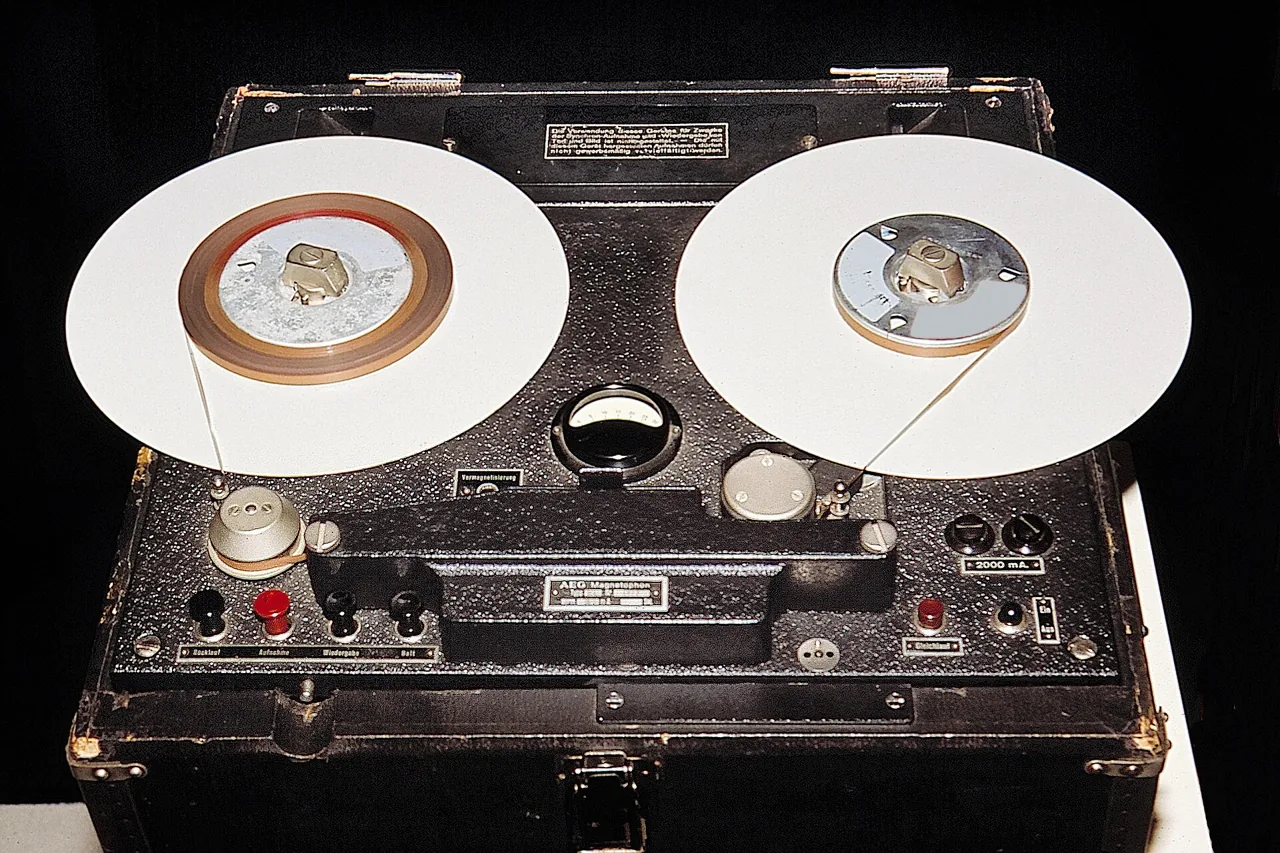
Photo: Friedrich Engel · CC BY-SA 3.0 · Source

Every reel-to-reel deck in a collector’s den owes something to one German machine. The best account of it I know is “A Selected History of Magnetic Recording,” by former BASF engineer Friedrich Engel and Peter Hammar, which the Audio Engineering Society hosts.
It starts with Fritz Pfleumer, an Austrian inventor in Dresden who made gold-colored bands for cigarette paper. He glued iron powder onto a 16 mm paper strip and received German patent DE 500 900 in January 1928. AEG signed him up, and AEG chairman Hermann Buecher struck a deal with BASF: AEG would build the machines, and BASF would make the tape. The name “Magnetophon” was chosen in June 1934.
A planned debut at the 1934 Berlin Radio Exhibition was called off because of motor hum and tape that broke too easily. The next year it worked. Engel and Hammar describe a new three-motor transport that “set the pattern for the modern tape recorder,” running 6.5 mm tape at one meter per second. A fatal fire destroyed the exhibition hall midway through the August 1935 show, and AEG’s team built two replacement machines in two days.
The big leap came later. In 1940, RRG broadcast engineer Walter Weber stumbled onto AC bias when a test amplifier went into oscillation. A public demonstration in Berlin on June 10, 1941, showed a 60 dB dynamic range and response from 50 Hz to 10 kHz.
Then comes the part I love. Major John T. “Jack” Mullin of the U.S. Army Signal Corps visited the Bad Nauheim station of Radio Frankfurt two months after the war in Europe ended. There he saw AC-bias Magnetophon studio machines in use. He gathered schematics for his Army reports and, following Army protocol, shipped parts for two K 4 transports home to San Francisco along with 50 reels of tape. Back home, he rebuilt them with American electronics.
When Mullin and his partner Bill Palmer measured the 6.5 mm tape, they called it a quarter inch, and 77 cm per second became 30 inches per second. That’s why your reels are the width they are.
The photo, by Engel himself, shows an AEG Magnetophon K4 from 1939.