Collections · Cassette
The Nakamichi Dragon: The 1982 Cassette Deck That Realigned Its Own Head
Nakamichi’s Dragon arrived in 1982 at $1,850 with NAAC, a servo system that corrected playback-head azimuth on the fly. Stereo Review measured the lowest wow-and-flutter of any cassette deck it had tested.
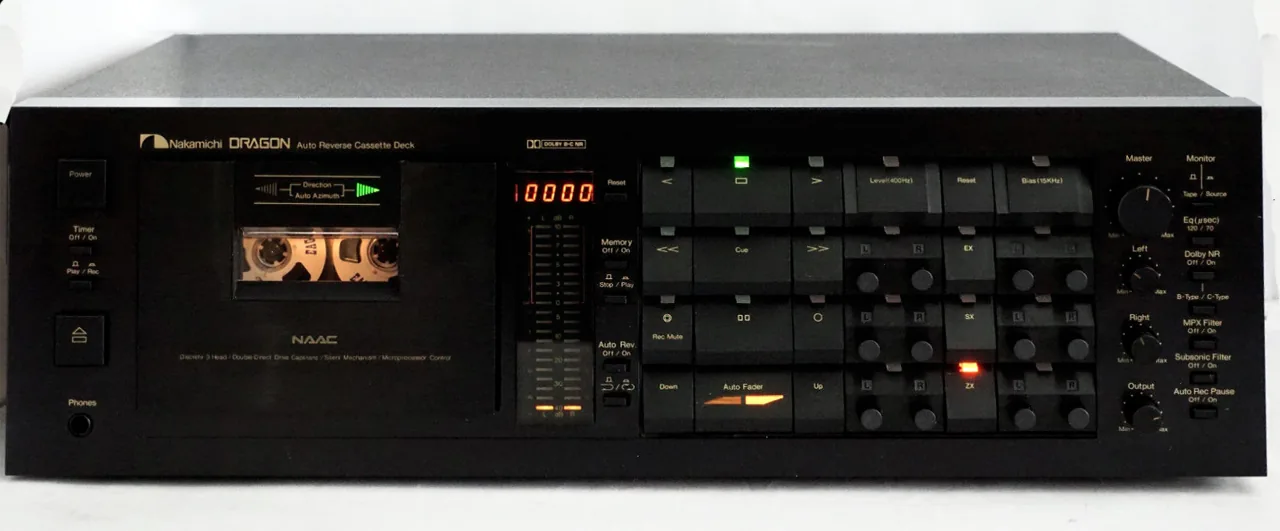
Photo: Bbadgett · CC BY-SA 4.0 · Source

Ask a cassette collector to name a grail deck, and there’s a good chance you’ll hear “Dragon.” In 2018, Sound & Vision reran Stereo Review’s original April 1983 test report, and its introduction explains why the deck still has that reputation.
The trouble with cassettes, as Rob Sabin writes in that introduction, is physics. A cassette swaps the quarter-inch tape and 7½ inches per second of a home reel-to-reel for a 0.15-inch strip moving at 1⅞ inches per second. On a strip that narrow, the playback head’s gap has to sit almost perfectly perpendicular to the tape. Any tilt, which is called azimuth error, can cost you a lot of treble. Flip the cassette, or play a pre-recorded tape made on someone else’s deck, and the alignment is off again.
Niro Nakamichi’s answer arrived in 1982 at $1,850, later repriced to $2,499. Sabin calls the Dragon “nothing short of an engineering marvel.” It had a beltless, springless dual-capstan transport with direct-drive motors controlled by a quartz clock. It even pushed away the cassette’s own pressure pad and relied on the motors alone to provide the pressure instead. In Craig Stark’s review, the Dragon measured the lowest wow-and-flutter of any cassette deck ever tested.
The headline feature, though, was Nakamichi Auto Azimuth Correction, or NAAC. Sabin describes it as a microprocessor-driven feedback loop that detected azimuth error in real time and corrected it with a servo-controlled head, even on pre-recorded tapes.
It didn’t last as a family trait. Sabin says the complexity and cost of NAAC, plus the difficulty of servicing auto-reverse machines, led Nakamichi to drop it from its later RX decks, which flipped the cassette mechanically instead. The Dragon itself held on until 1993, an 11-year run.
The photo shows a Dragon’s front panel. If you find one, keep Sabin’s point about servicing in mind. All that cleverness is hard to repair.