Collections · History
A Wooden Block in a Jacket Pocket: How Philips Sized the Compact Cassette in 1963
The Philips Museum’s history of the Compact Cassette covers Lou Ottens’s pocket-sized wooden block, the EL 3300 Pocket Recorder’s debut at the 1963 Berlin radio show, and the free license that made the cassette a world standard.
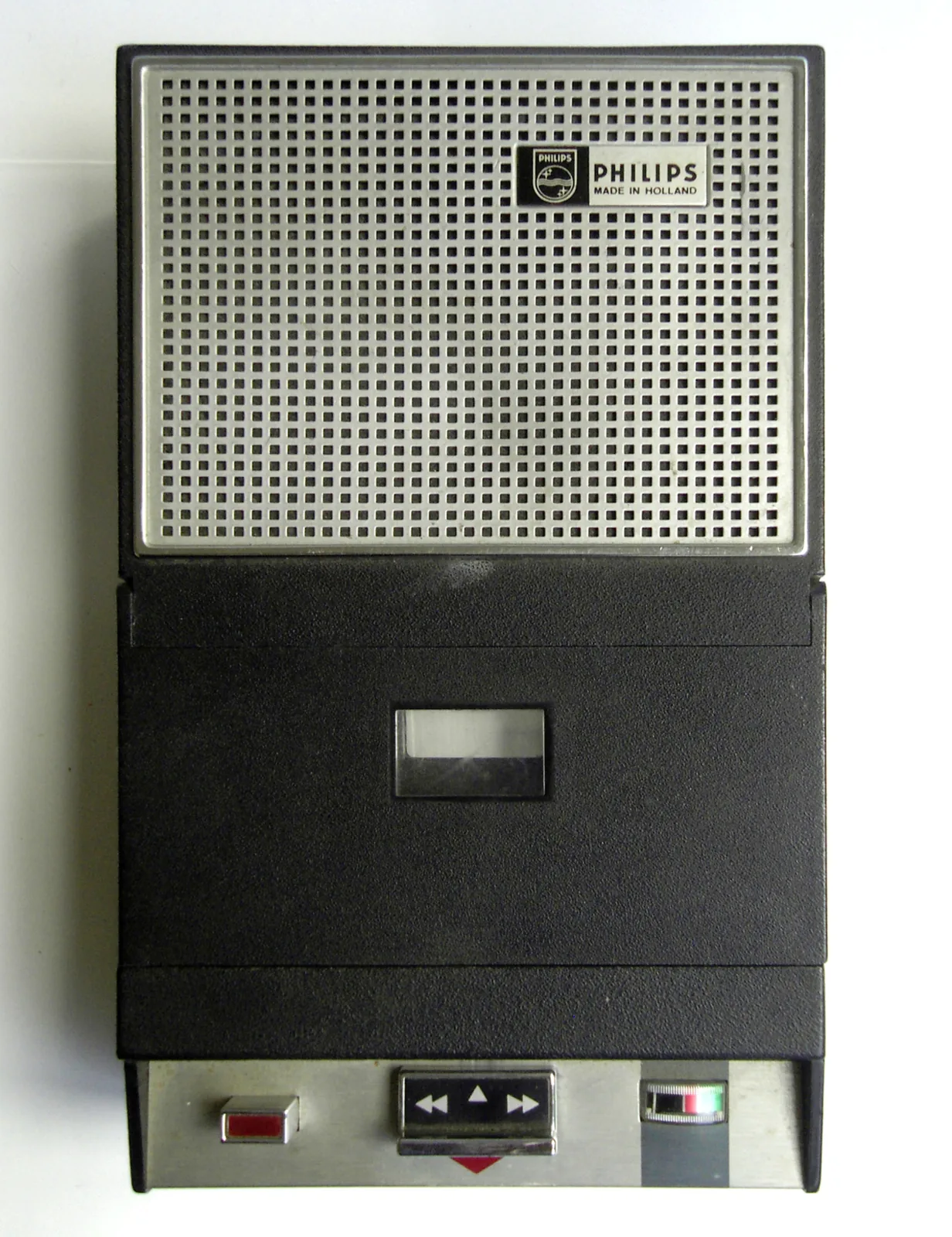
Photo: Erkaha, adjustment by Retired electrician · CC BY-SA 4.0 · Source

Every cassette Walkman on my new Walkman Timeline exists because of a plastic box Philips introduced in 1963. The Philips Museum has published the Compact Cassette’s origin story, and it starts with a wooden block.
In 1961, according to the museum, the recorder development group at Philips in Hasselt, Belgium, was asked to build a small battery-powered magnetic recorder and a cassette to go with it. Lou Ottens had headed the product development department at Hasselt since 1957. He focused on ease of use, so that anyone could operate the machine, even the clumsiest. Then he had a wooden block cut to fit his jacket pocket. That block set the size of both the cassette and the recorder. The museum quotes Ottens: “Small equals portability, low energy consumption and low cost. Those three features are very attractive to the customer.” Sadly, the museum notes, the block itself wasn’t kept.
The museum says the original goal was recording speech. Within a few months the team was aiming for quality good enough for music too. The Philips Pocket Recorder EL 3300 and its EL1903 cassette were first shown to the public at the Internationale Funkausstellung in Berlin in August 1963. The museum says the recorder caused a sensation, and Ottens recalled Japanese visitors busily taking notes and photos at the Philips stand.
Copies arrived within a year, so Philips made a choice that collectors still benefit from. It granted other manufacturers a free license to the compact cassette system, as long as they kept to its technical rules. One standard meant any tape played in any deck. By September 1967, the museum says, the Philips Courier counted seventy companies making cassette recorders.
Pre-recorded Musicassettes followed in March 1965, made with Polygram, alongside the EL 3301 recorder. Ottens himself didn’t share the nostalgia. “The cassette is history,” he said, according to the museum.
The photo shows a first-generation Philips portable cassette recorder. The uploader identifies it as an EL 3300 or a direct derivative.